
Transmission expansion
As our province grows in population and industry, our energy needs increase. We’re constantly working to enhance our electrical service capacity and expand our natural gas service areas.
Our system expansion projects:
- Pointe du Bois renewable energy project;
- Portage la Prairie area restoration and expansion;
- Radisson to Henday transmission line (R44H);
- Silver to Rosser tap transmission line.
Transmission explained
Learn more about transmission and its valuable role in delivering the reliable, affordable energy you count on.
From the start to the end point, potential effects to human, technical, and natural environments are part of the selection of a transmission line routing process.

What is transmission? How does it fit into our system?
Watch to learn where our electricity comes from and how it gets to the places we use it.
Video: 1:52

The value of electricity exports
Watch our video to learn more about transmission connections and the value of exports to our customers.
Video: 2:26

The value of reliability
Watch our video to learn more about transmission connections and the value they provide our customers by enhancing reliability.
Video: 2:14

Why does Manitoba need new transmission?
Watch to learn how the demand for electricity has increased and how we need to change our system to accommodate the growing need.
Video: 2:28

How do we develop transmission lines?
Watch to learn how we work with communities to minimize the effects of transmission lines on people and the environment.
Video: 2:29
Bipole lines
Manitoba Hydro is known around the world for our development of transmitting high-voltage direct current (HVDC) electricity over long distances.
HVDC transmission helped untap the tremendous hydroelectric potential of the Nelson River in the 1960s, bringing electricity produced by generating stations on the river to southern Manitoba.
The Nelson River HVDC transmission system includes 3 lines called Bipole I, Bipole II, and Bipole III. Bipole refers to the positive (+) pole and a negative (−) pole which allows electricity to travel great distances without much loss of power.
Before Bipole III’s completion in 2018, over 70% of electricity generated in Manitoba was delivered to customers through Bipole I and Bipole II.
These 2 transmission lines run alongside each other for much of their 895-km route, starting at the northern Radisson and Henday converter stations near Gillam. Both lines end in the south at the Dorsey converter station just northwest of Winnipeg.
Because of their proximity to each other, a severe weather event could damage Bipole I and Bipole II at the same time. This would have left us unable to transmit enough electricity to meet demand, and result in extended outages and potential blackouts.
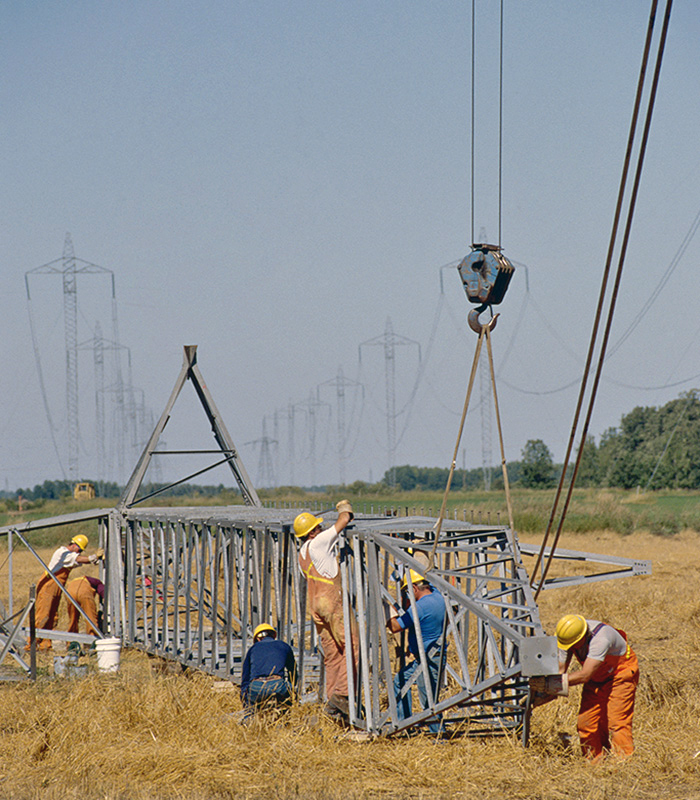
In 1996, high winds knocked down 19 towers on Bipoles I and II. For the first time in history, Manitobans were asked to reduce their non-essential power consumption while the towers were fixed over 4 days — they responded with an 8% reduction.
Enlarge image: Manitoba Hydro crew in a grass field build a new bipole tower on the ground.
The Bipole III HVDC transmission line has a total of 3,078 towers erected on a different route through western Manitoba and two new converter stations. It begins at the Keewatinohk converter station approximately 80 km northwest of Gillam, and ends at the Riel converter station just east of Winnipeg.
Bipole III provides 2,000 MW of additional capacity, and an independent and physically separate HVDC system. This significantly reduces the impact severe weather events may have on the HVDC system in the future, and increases the reliability of delivery of electricity to our customers.
Length of lines:
- Bipole I: 895 km;
- Bipole II: 937 km;
- Bipole III: 1,400 km.

HVDC system
The history and development of our HVDC system.
Video: 2:03
Compressed natural gas station
Our compressed natural gas (CNG) station in southwest Winnipeg provides a back-up supply of natural gas to over 296,000 natural gas customers across southern Manitoba.
The CNG station allows us to respond in emergencies, plan outages for repairs without a disruption in supply, and provide a safe and more reliable distribution network for our customers.
How a compressed natural gas station works
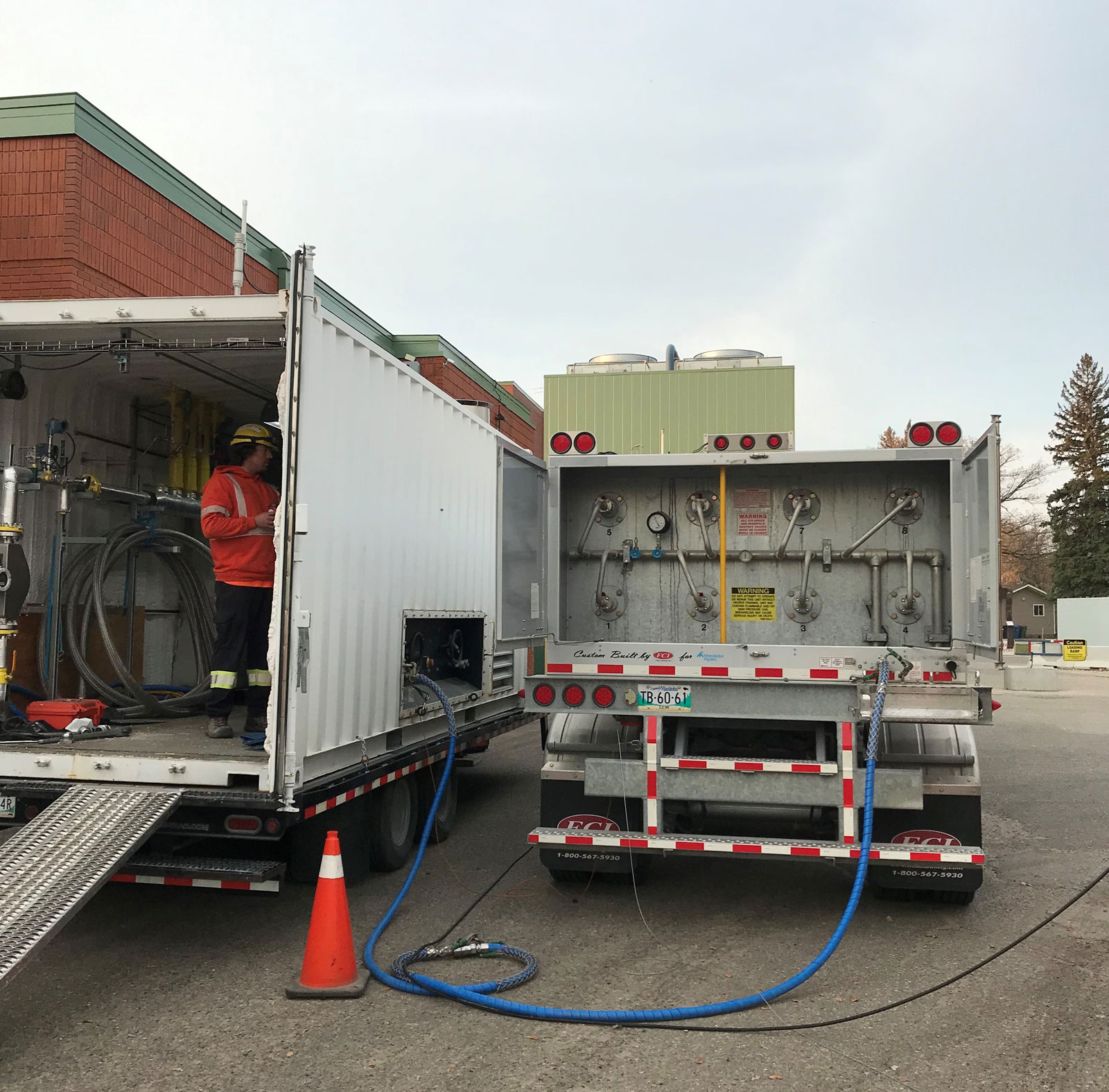
A compressed natural gas trailer in Dauphin supplying temporary gas during the Minell pipeline outage in October 2021. A trailer can hold 10 to 12 hours of natural gas. A second trailer can switch it out so there is a constant supply of gas to critical services.
Enlarge image: A compressed natural gas trailer supplying temporary gas during an outage.
The CNG station is located southwest of Winnipeg, close to most of our natural gas customers.
A CNG station looks similar to a gas station. If supply is disrupted in a natural gas line, CNG tube trailers can be filled with compressed natural gas and driven to the site. The transport truck connects to a local injection point in the distribution system and natural gas is restored to the customer while repairs are undertaken.
The need for a back-up supply became evident after an incident in Otterburne in January 2014 on TransCanada Corporation’s pipeline. Over 4,000 homes and approximately 15,000 people in south-central Manitoba were left without natural gas for days. Our electrical system was strained, as people heated homes with electric space heaters and stoves.
We can mobilize CNG trailers to inject natural gas into the local distribution system, which helps maintain pressure in the system and augments gas service to customers in cases where there may be an issue with the main pipeline.
We have multiple trailers that can operate in a rotation like we did in Dauphin in October 2021 due to a third-party damage to the Minell Pipeline.

Compressed natural gas station now in operation
Manitoba Hydro’s new compressed natural gas station near Winnipeg is now in full operation.
Video: 1:49
Minell pipeline
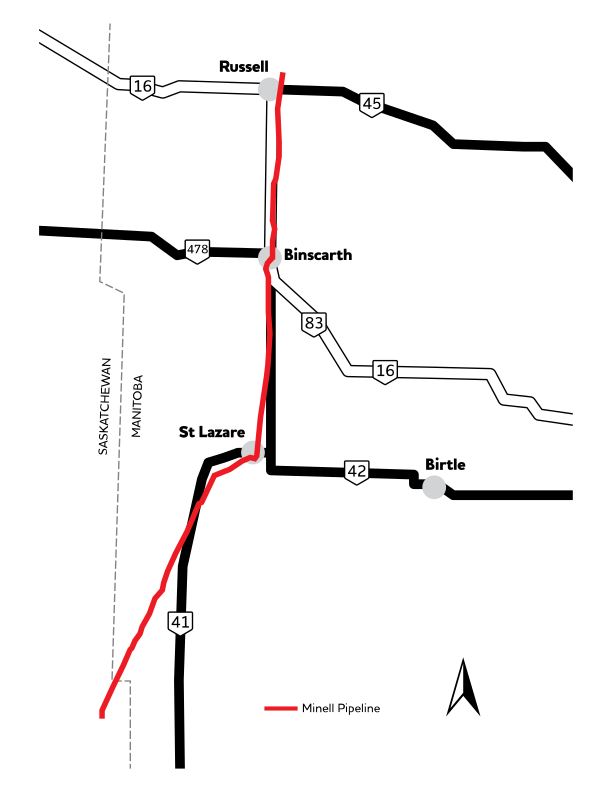
The Minell pipeline crosses the Saskatchewan–Manitoba border and travels up to Russell MB.
Enlarge image: Map shows the Minell pipeline location in Saskatchewan and Manitoba.
The Minell pipeline is our transmission pressure natural gas pipeline. The pipeline starts near Moosomin, Saskatchewan, travels to the Saskatchewan–Manitoba border, then north to Russell, Manitoba.
Transmission pressure pipelines are used to transport large quantities of natural gas. Compressor stations are built every 80 to 160 kilometres along the transmission pipeline, allowing pressure to be increased as needed to keep the gas moving.
Canada Energy Regulator
The Minell pipeline is regulated federally by the Canada Energy Regulator (cer-rec.gc.ca) (CER). CER establishes and enforces the rules and regulations governing activity types permitted within the Minell pipeline’s prescribed area – an area 30 metres on either side of the pipeline’s centerline. The right-of-way (ROW) falls within the prescribed area and can vary in size.
We have placed permanent pipeline markers along the Minell pipeline to show its approximate location at roads, railways, and other sites.
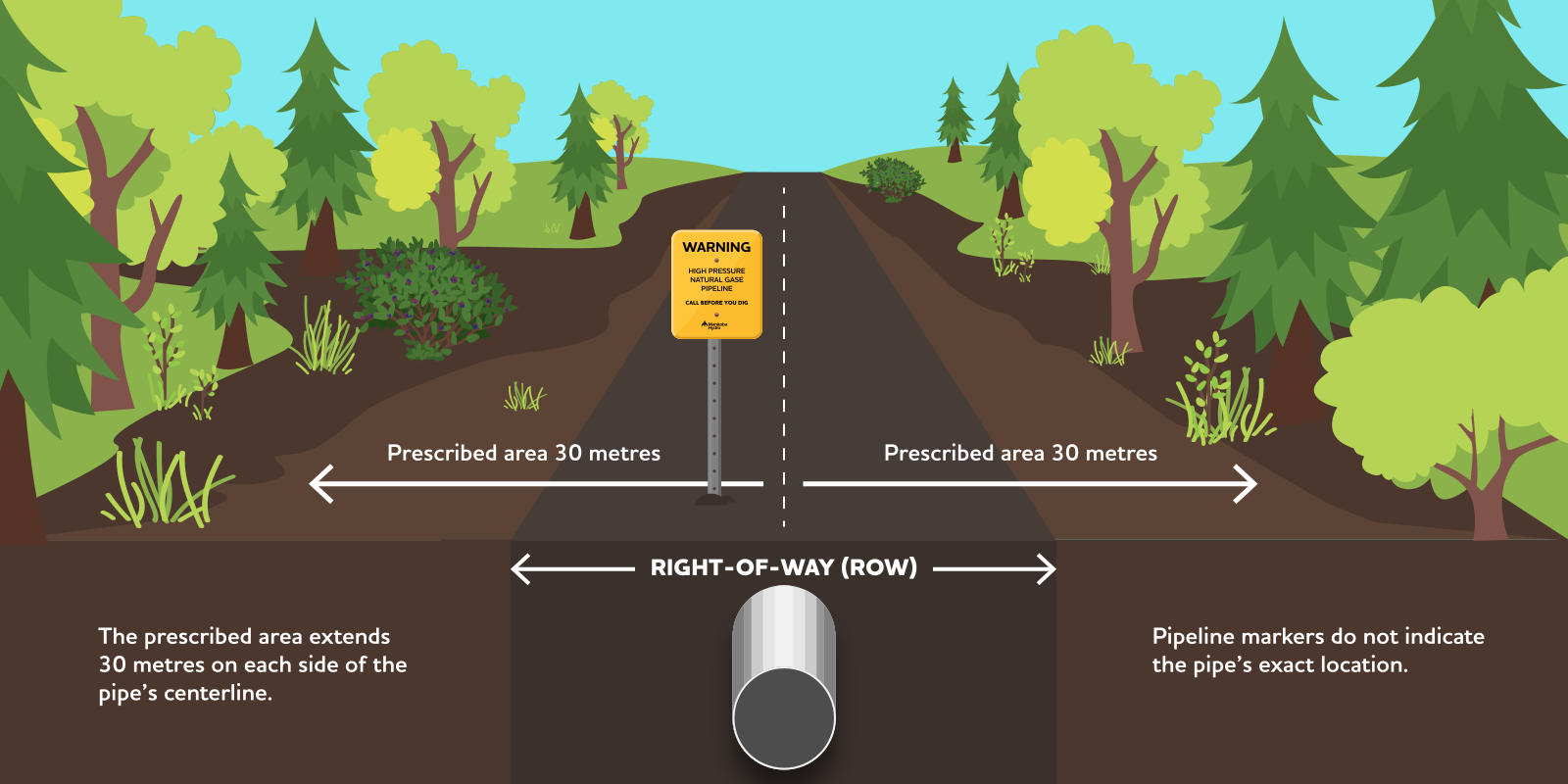
The prescribed area and right-of-way on the Minell pipeline. Warning signs are posted along the pipeline.
Following CER regulations helps prevent contact with and damage to the pipeline. This also promotes the safety of everyone working and living near the pipeline and protects the surrounding environment. These regulations must be strictly observed by both landowners and us when working near and within the prescribed area.
If a person or company does not comply with CER’s regulatory requirements, CER may take enforcement actions such as monetary penalties or suspension of activities to ensure compliance.
Agricultural and working activities in the ROW
The closer your activity is to the ROW, the greater the risk of coming in contact with the pipeline. CER regulations require that before you perform certain activities within the pipeline’s ROW, you must have our written authorization.
Activities requiring written authorization include, but are not limited to:
- any activity that digs 30 cm or deeper in the prescribed area and the ROW;
- any activity resulting in a reduction or removal of the earth cover (depth of soil) over the pipeline;
- building anything (for example, shed or fence);
- cultivation to a depth of 45 cm or deeper (unless we notify you that it is unsafe to do so in certain areas);
- driving vehicles or mobile equipment over a pipeline (unless it is for low-risk agricultural purposes such as planting or disking, or on a public roadway);
- placing or storing anything on the ROW such as a berm, wood pile, or a parked vehicle.
Cultivation restrictions
Cultivation refers to preparing land for producing crops. Unless we advise you, you may perform shallow cultivation such as disking, plowing, harrowing, and pasturing without our written authorization. This does not include activities such digging or building on the ROW or prescribed area.
Should any of these activities result in a reduction or removal of the earth cover over the pipeline, you must have our written authorization before performing the activity.
Agricultural and working activities in the prescribed area
CER has established regulations over activities (agricultural and otherwise) that may be performed in the prescribed area. CER regulations require that before you perform certain activities such as driving across the pipeline, constructing a facility, or other work that can result in a ground disturbance, you must have our written authorization.
Ground disturbance restrictions
A ground disturbance is any activity that moves or penetrates the ground. Such activities can increase the probability of contact and damage to the pipeline. CER regulations recognize a ground disturbance as an activity within the prescribed area that involves any of the following:
- agricultural cultivation to depths of 45 cm or deeper below the surface of the ground;
- any activity, other than cultivation, to a depth of 30 cm or deeper (for example, digging);
- any activity resulting in a reduction or removal of the earth cover over the pipeline, such as, but not limited to:
- building a driveway, private road, lane, or parking lot or pad;
- building fences, driving posts, or drilling holes with an auger;
- building structures such as a pool, retaining wall, shed, or garage;
- clearing land, felling trees, stump removal, or planting or removing trees;
- crossing buried pipelines with heavy vehicles off a roadway;
- digging or excavating;
- deep tillage, trenching, or quarrying;
- ditching or ditch clearing;
- drain tiling;
- installing or maintaining overhead lines;
- installing a manure pit;
- land levelling, grading, or road projects;
- landscaping;
- laser levelling;
- pile driving, post pounding, or installing bollards;
- sodding or topsoil stripping.
You must not use mechanical excavation that results in a ground disturbance within 3 metres of the pipeline unless you follow the measures in the regulations.
The Minell pipeline is buried at a depth to prevent damage from normal agricultural activities (see cultivation restrictions above).
CER’s Agricultural Activities Near Pipelines (.PDF, 7.7 MB, cer-rec.gc.ca) requires that if your work or activity involves a ground disturbance you must request a line locate and receive our written authorization. This ensures you can safely perform your requested activity and that all pipeline locations are marked before you start the activity. We perform line locates at no cost to the landowner.
Moving vehicles and equipment across the pipeline
Our authorization for vehicle crossings is usually not required if the crossing is on a public roadway.
If not on a public roadway, moving vehicles or equipment over the pipeline can increase the stresses on the pipe. Such activities can reduce or remove earth cover over the pipeline and increase the odds that your equipment may damage the pipeline.
Driving with narrow tires or old equipment, especially in damp conditions, may cause ruts. Ruts 30 cm or deeper in the prescribed area are considered a ground disturbance. You must contact us before you move a vehicle or equipment if there is a risk of ruts. There may also be occasions when we implement restrictions, potentially reducing the 30 cm depth allowance within the prescribed area. Any such supplementary restrictions will be communicated by letter, and we will actively work with the affected landowner to resolve the situation.
Moving a vehicle or equipment across a pipeline, including over the ROW, is prohibited by CER unless:
- it is for low-risk agricultural purposes such as planting or disking;
- you have received our written authorization;
- it is within the travelled portion of a highway or public roadway.
We will consider all factors before authorizing the driving or moving of equipment over the pipeline. Such factors include, but are not limited to:
- creation of pressures on the pipe by static and dynamic loads;
- depth of earth cover above the pipeline;
- frequency of crossing activities;
- ground conditions;
- operating stresses experienced by the pipe;
- soil type;
- type of pipe;
- type and size of your equipment.
We may also consider the following to determine if the equipment can be used safely on the ROW and in the prescribed area:
- gross vehicle weight rating (GVW);
- load;
- number of axles;
- size;
- tire pressure or ground pressure;
- vehicle class.
Only we can assess this information and instruct how and where your vehicles and equipment can safely cross. Landowners should regularly review and confirm with us where you, your staff, and contractors can cross the pipeline.
Agricultural vehicles and equipment in the prescribed area
Most conventional agricultural equipment and vehicles can operate normally in low-risk areas of the prescribed area. Our authorization for vehicle crossings is not usually required if the crossing is on a public roadway but some larger equipment and vehicles may be too heavy. The maximum load depends on both the axle weight and the tire pressure or ground pressure.
We will assist you in determining the permitted maximum load to ensure you are not violating CER regulations. Heavy loads such as water, liquid fertilizer, manure, or grain may be a risk to the pipeline.
You must have our written authorization before operating heavy vehicles or equipment over the Minell pipeline if:
- the vehicle or mobile equipment does not meet RTAC (Roads and Transportation Association of Canada) Guidelines and have axle loadings exceeding 32,000 lbs;
- the loaded axle weight and tire pressures of the vehicle or mobile equipment do not meet the manufacturer’s approved limits and operating guidelines;
- we have notified you that the point of crossing at a location could impair the pipeline’s safety or security.
- the vehicle or mobile equipment belongs to one of the equipment listed below.
If the vehicle crossing is not for an agricultural activity, you must have written authorization from us before crossing the ROW.
CER regulations also require that certain types of equipment have our written authorization before operating in the prescribed area including, but not limited to:
- grain carts;
- grain/haul trucks, super B trains, and trailers carrying heavy loads (water, liquid fertilizer, manure, grain, etc.);
- augers and trenchers;
- backhoe and grader;
- deep tillage/rippers and tiling equipment;
- fence post pounders;
- laser leveler;
- skid steer;
- tree spade.
Constructing a facility
Prior to constructing any facility across, on, along, or under the prescribed area and ROW, you must:
- receive our written authorization to perform the activity;
- make a line locate request with us;
- follow all safety information that we provide.
Examples of facilities can include, but are not limited to:
- a built or installed structure (for example, a fence, concrete conduit structure, swimming pool, retaining wall, shed, rink, shed, gazebo, sign, tree, or any structure on the ROW);
- a drainage or irrigation system, including dykes, ditches, and culverts;
- a highway, private road, lane, parking lot, walkway;
- a pipe (for example, water main, sewer, gas line, oil line);
- a railway;
- a telecommunications line or power line;
- any vehicle parked on the ROW (for example, cars, boats, trailers, RVs, buses).
It is the responsibility of the person performing the ground disturbance in the prescribed area or ROW to ensure that a line locate request has been made. All buried facilities must be identified, and their locations marked, before any work or activity commences.
Working safely around the pipeline
For more information about working safely around the Minell pipeline, call us toll-free at 1‑888‑624‑9376 (1‑888‑MBHYDRO).
To apply for written authorization for your construction or excavation project, complete our online natural gas project review.
Learn more about CER regulations governing activities within the Minell pipeline’s prescribed area and ROW:
- Pipeline Damage Prevention Regulations - Authorizations (SOR/2016-124) (laws-lois.justice.gc.ca)
- Agricultural Activities Near Pipelines (.PDF, 7.7 MB, cer-rec.gc.ca)
- Agricultural vehicles and equipment in the prescribed area (cer-rec.gc.ca)
- Guidance Notes – Canadian Energy Regulator Regulations for Pipeline Damage Prevention (cer-rec.gc.ca).
Know what’s below
As well as federally regulated pipelines, there may be provincially and locally regulated facilities such as pipelines and cables in your work area. These facilities may include oil and gas field gathering pipes, gas distribution systems, fibre optic telecommunication cables, water and sewer lines, and electrical cables.
Before you start any activity, contact Manitoba and Saskatchewan line locate services:
For emergency line locate requests, call both utilities at their toll-free numbers:
- Manitoba Hydro at 1‑800‑940‑3447.
- SaskPower at 1‑866‑828‑4888.
International power lines
Our international power lines (IPLs) are regulated federally by the Canadian Energy Regulator (cer-rec.gc.ca) (CER). The CER establishes and enforces the rules and regulations governing activity types permitted within the right-of-way area of an international power line. CER rules and regulations apply to the right-of-way. In circumstances where no right-of-way is registered, CER rules and regulations apply to the prescribed area which is within 30 metres from either side of the centerline of the power line.
We have permanent warning markers on all of our international transmission towers.
Following CER regulations promotes the safety of everyone working and living near the IPLs. It helps prevent contact with, and damage to, the IPLs, and protects the surrounding environment. These regulations must be strictly observed by both landowners and Manitoba Hydro when working near and within the right-of-way or prescribed area (where no right-of-way is registered).
If a person or company does not comply with the CER’s regulatory requirements, the CER may take enforcement actions such as monetary penalties or suspension of activities to ensure compliance.
Locations of our international power lines
We have 5 IPLs:
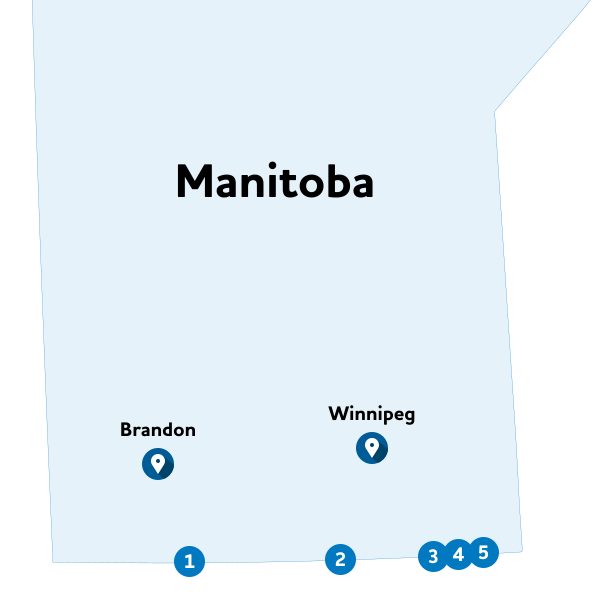
- Glenboro to Peace Gardens
- Letellier to Drayton
- Manitoba-Minnesota Transmission Line
- Riel to Forbes
- Richer to Moranville
Agricultural and working activities in the right-of-way
The closer your activity is to the right-of-way, the greater your risk of coming in contact with an IPL. CER regulations require that before you perform certain activities within the IPL’s right-of-way, you must have our written authorization.
Activities requiring written authorization include, but are not limited to:
- Construction of a facility across, on, along or under an international power line.
- An activity that reduces the height of clearance between the overhead transmission line to the ground.
- An activity that causes a ground disturbance greater than 30 cm or any activity that removes coverage within the right-of-way area of an international power line (or if no right-of-way is registered for the international power line, within 30 metres from the centerline of the power line). A ground disturbance is any activity that moves or penetrates the ground excluding cultivation to a depth of less than 45 cm or any activity to a depth less than 30 cm that does not result in reduction of the earth cover.
- Operation of a vehicle or mobile equipment across an international power line outside of the travelled portion of a highway or public road.
Cultivation restrictions
Cultivation refers to preparing land for producing crops. Unless we advise otherwise, you may perform shallow cultivation (less than 45 cm in depth) such as disking, plowing, and harrowing without our written authorization. This does not include activities such as land grading for drainage within the right-of-way or prescribed area.
Constructing a facility
Prior to constructing any facility across, on, along, or under the right-of-way and prescribed area, you must:
- receive our written authorization to perform the activity;
- make a line locate request with us;
- follow all safety information provided by us.
Examples of facilities can include, but are not limited to:
- a built or installed structure (for example, a fence, concrete conduit structure, swimming pool, retaining wall, shed, rink, gazebo, sign, tree, or any structure within the right-of-way);
- a drainage or irrigation system, including dykes, ditches, and culverts;
- a highway, private road, lane, parking lot, walkway;
- a pipe (for example, water main, sewer, gas line, oil line);
- a railway;
- a telecommunications line or power line;
- any vehicle parked within the right-of-way (for example, cars, boats, trailers, RVs, buses).
It is the responsibility of the person performing the ground disturbance in the prescribed area or right-of-way to ensure that a line locate request has been made. All buried and overhead facilities must be identified, and their locations marked, before any work or activity commences.
Work safely near our IPLs
For more information about working safely around IPLs, call us at 1‑888‑624‑9376 (1‑888‑MBHYDRO).
To apply for written authorization for your construction or excavation project email us.
Learn more about CER regulations governing activities within an IPL’s prescribed area and right-of-way:
- Canada Energy Regulator: International and Interprovincial Power Line Damage Prevention Regulations – Authorizations, SOR/2019-347 (laws-lois.justice.gc.ca);
- Canada Energy Regulator: International and Interprovincial Power Line Damage Prevention Regulations – Obligations of Holders of Permits and Certificates, SOR/2020-49 (laws-lois.justice.gc.ca).
Click before you dig
There may also be provincially and locally regulated facilities such as pipelines and cables in your work area. These facilities may include oil and gas field gathering pipes, gas distribution systems, fibre optic telecommunication cables, water and sewer lines, and electrical cables.
Before you start any ground disturbance activity, contact ClickBeforeYouDigMB.com or call 1‑800‑940‑3447.
For emergency line locate requests, call Click Before You Dig Manitoba at 1‑800‑940‑3447.
Transmission line routing process
Transmission lines are sets of wires, called conductors, that carry electric power from station to station. Distribution lines then deliver that power to customers.
We use a process that is based on an internationally recognized methodology to select preferred transmission line routes. This process has been used on more than 200 transmission projects in North America and we used it first for the St. Vital Transmission Complex in 2013.
This process incorporates data gathering, fieldwork, and technical and environmental considerations. We also collect input from landowners, Indigenous communities, interested parties, the public, and project specialists in various fields. These perspectives help to minimize the overall impact of the project.
Route selection timelines depend on the project. They are closely associated with engagement and environmental assessment.
How we select a preferred route
There are a few stages in the transmission line routing process. These 5 stages outline how an area with many possible routes will lead to a final preferred route:
-
Determine a route planning area
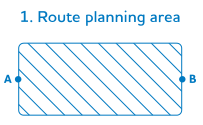
- We choose the start and end points and develop a broad route-planning area based on opportunities and constraints on the landscape.
-
Plan alternative routes
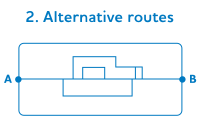
- We draw segments connecting the start and end points within the route-planning area. These segments form alternative routes that we present during the engagement process. Project specialists who represent different perspectives including agriculture, heritage, and engineering also provide feedback.
-
Develop mitigative segments
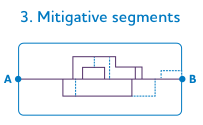
- We add or modify route segments based on feedback during the engagement process and from project specialists. A mitigative segment is an addition that is made to part of the route based on feedback.
-
Determine a preferred route
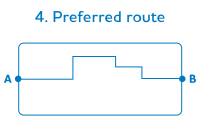
- A comparative evaluation of alternative routes is done to choose a preferred route that is presented during the engagement process. Our project specialists focus their evaluations on this area to better understand potential effects of the preferred route on people and the environment.
-
Finalize the preferred route and submit an environmental assessment report
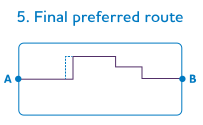
- After our preferred route presentation, we consider potential changes based on feedback from the engagement process and project specialists. After incorporating that feedback, we determine a final preferred route and present it to Manitoba Environment, Climate and Parks (gov.mb.ca) for review. The provincial regulator considers comments and questions from the public and Indigenous communities when they determine whether to issue an Environment Act Licence for the project.
These are general steps in transmission line routing. Some projects, based on their complexity, may need more or fewer steps to determine a final preferred route.
Moving between each stage (PDF, 75 KB)
The decision-making process cycle: planning; feedback and analysis; comparative evaluation; and selection.
How we develop project criteria
Engagement process feedback helps to develop criteria that will be used to evaluate the strengths and weaknesses of route options. These criteria represent the natural, the built, and engineering perspectives.
Examples of criteria:
- natural environment: natural forest, wetlands, stream and river crossings;
- engineering: project cost, existing transmission line crossings, length;
- built environment: proximity to residences, land use and capability, historic resources, public use areas.
We then compare a subset of routes to select a preferred route. We take into account:
- cost;
- community considerations;
- reliability;
- risk to schedule;
- built environment.
Mitigative segments
A mitigative segment is a part of the route that is added to the transmission line routing process based on feedback during the engagement process or from our project specialists. These segments are added to address concerns or a potential effect on the landscape.
We evaluate these segments for technical feasibility and cost. We also consider whether or not the segment will shift effect from one landowner to another. If our evaluations deem the new segments are reasonable, they are incorporated into the comparative evaluation of routes to determine a preferred route.
How we determine the final preferred route
We work with a range of environmental, socio-economic, and technical specialists. We work to balance concerns and feedback from the Indigenous communities, landowners, project specialists, interested parties, and the public. Our goal is to achieve consensus between the project team on the final preferred route. The route is considered final once approved by the regulator.
Contact us
For more information about the transmission line routing process:
- Learn more about our transmission projects.
- Phone toll free at 1‑877‑343‑1631.
- Email Transmission & Distribution Environment and Engagement.