
Burntwood, Churchill, and Nelson Rivers, spring 2026 #2
Spring water outlook for northern Manitoba Rivers
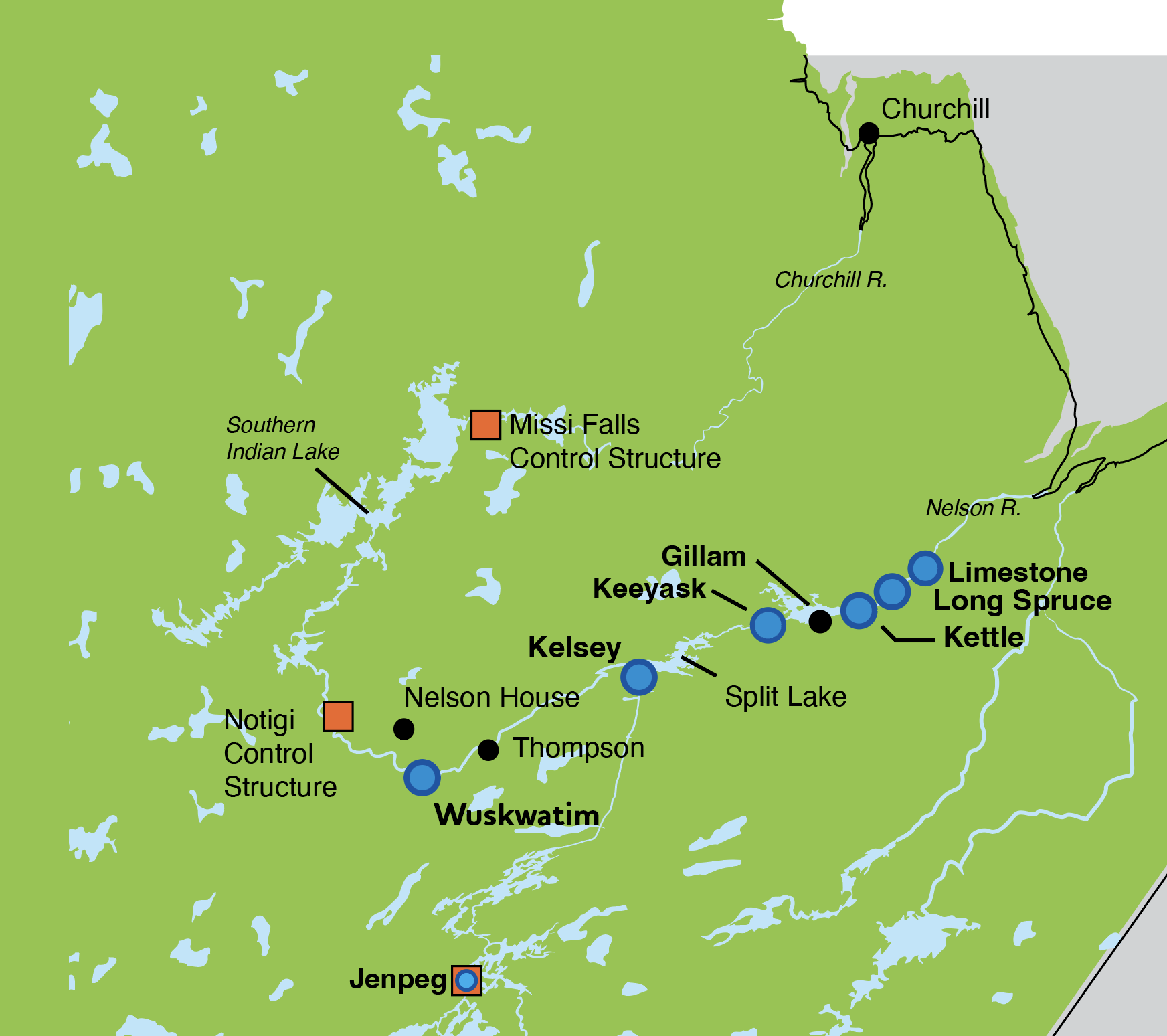
Map of Churchill and Nelson rivers with control structures and generating stations.
Enlarge image: Map of Churchill and Nelson rivers with control structures and generating stations.
Churchill River and Nelson River Basins
Spring melt is starting and will continue for the next few weeks.
The snowpack in the Churchill and Nelson River watersheds is above average.
Within the Burntwood, Churchill, and Nelson River areas, precipitation since October 2025 is near a 40-year high, however over the past year precipitation is at a 1 in 20-year low. Projected runoff from this winter’s high snowfall is expected to support the recovery from severe drought.
Lower Churchill River (Southern Indian Lake to Hudson Bay)
Current inflows from Saskatchewan to Southern Indian Lake (SIL) are slightly less than 20,000 cubic feet per second (cfs) and are expected to rise from spring melt.
The level of SIL is below average for this time of year at 843.7 ft and is expected to rise with the spring melt in mid-May. Outflows through the Missi Control Structure are around 1,775 cfs which is typical for this time of year and are scheduled to decrease to 750 cfs once open-water conditions emerge.
The lower Churchill River remains iced-over. Average peak flows of about 56,500 cfs are expected near Churchill between mid-May and mid-June.
Burntwood River
Much of the Churchill River flow is diverted out of SIL through the Churchill River Diversion via the Notigi Control Structure to the Rat and Burntwood rivers. Flows through Notigi were around 25,000 cfs in early winter, decreased to around 22,000 cfs in February, are currently about 24,000 cfs this spring and are expected to rise to 35,000 cfs by early-to-mid summer.
Nelson River Basin
Water conditions on the Nelson River are low to moderate. The Nelson River flow is at a 1 in 4-year low and increasing. Lake Winnipeg is at 712.7 ft. This is higher than last year, but still around a 1 in 8-year low level.
Water levels on Cross and Sipiwesk lakes will begin to increase through the spring due to an increase in local runoff and filling of the Kelsey forebay.
Changes in precipitation affect Manitoba Hydro’s operations and water levels across the system. Manitoba Hydro closely monitors water supply conditions across the entire Nelson-Churchill River drainage basin and updates its forecasts and operating plans weekly to ensure adequate energy supply.
Long-term precipitation forecasts are unreliable, and there remains considerable uncertainty in water level projections for the late spring and summer period. Manitoba Hydro will continue to provide spring outlooks for the Lower Churchill, Burntwood and Nelson Rivers in the coming weeks.
The Outlook is based on a combination of current and forecasted weather data from Environment and Climate Change Canada; recent and historic stream flow conditions based on both federal and Manitoba Hydro data; Manitoba Hydro regulation models for Reindeer Lake and SIL; snow surveys conducted by Manitoba Hydro; and snowpack estimates from satellite data.
Note that spring flows depend on how long it takes for snow to melt (for example, warm temperatures will cause a fast melt and higher water flows, while cooler temperatures will cause a slow melt and moderate flows for a longer period of time). Conditions can also change rapidly if a large rainfall or snowfall event occurs. Outlook information will be updated as conditions change.
If you have any questions or concerns, please contact:
Waterway Community Engagement
204‑360‑3505
WCE@hydro.mb.ca